

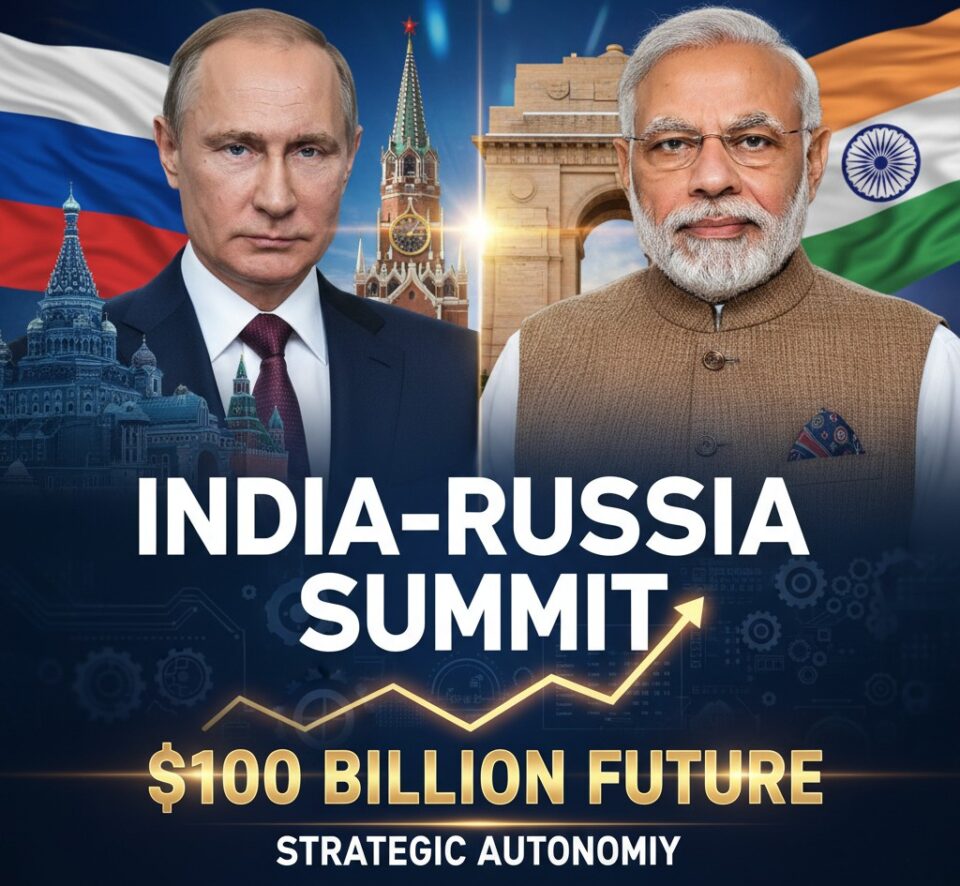
India-Russia Summit: Forging a $100 Billion Future and Strategic Autonomy
The highly anticipated visit of Russian President Vladimir Putin to New Delhi on December 5, 2025, for the 23rd Annual India-Russia Summit, is not merely a diplomatic engagement; it is a profound affirmation of the “Special and Privileged Strategic Partnership”. This summit is set to unlock transformative opportunities, solidifying India’s strategic autonomy and fueling its ambition to become a Viksit Bharat (Developed India) by 2047.
India-Russia: The agenda is comprehensive, focusing on converting the current relationship—historically strong in defence and energy—into a deep, diversified economic and technological collaboration. The discussions, prepared by recent high-level meetings including Foreign and Commerce Secretaries, are centered on a singular, forward-looking goal: achieving $100 billion in bilateral trade by 2030.
Defence Cooperation: Powering ‘Make in India’
A cornerstone of the India-Russia relationship, defence is now being redefined to align with India’s ‘Make in India’ and Atmanirbhar Bharat initiatives. The summit is expected to seal agreements that go far beyond simple procurement:
-
Technology Transfer (ToT): The focus is on securing crucial Russian technology for local, licensed manufacturing. Key projects like the phased delivery of the S-400 missile defence systems and continued support for flagship platforms (T-90 tanks, Su-30 MKI jets) will be reviewed.
-
Joint R&D: Discussions are aimed at moving towards genuine co-production and co-development, building on the success of the globally recognized BrahMos cruise missile program. Future talks will likely focus on next-generation systems, ensuring India remains strategically prepared.
By diversifying its defence production and gaining critical know-how, India strengthens its security posture while simultaneously boosting its domestic industrial base and creating high-skilled jobs.
Balancing Trade with Investment and Payments
While bilateral trade recently hit a record of nearly $68.7 billion (FY 2024-25), the imbalance—heavily skewed towards India’s energy imports—is a priority. The summit will address structural mechanisms to transform this challenge into an opportunity for Indian exporters:
-
Market Access for Indian Goods: India is aggressively seeking expedited clearances for its key exports, including pharmaceuticals, marine products, engineering goods, and textiles, which will directly benefit Indian MSMEs and help bridge the trade deficit.
-
Alternative Payment Mechanisms: Both sides are committed to developing robust, non-dollar payment solutions, particularly for MSMEs.6 This strategic move de-risks trade from geopolitical pressures and facilitates smoother commercial transactions using the Rupee-Ruble settlement system.
-
Capital Investment Flow: Russia’s accumulation of Rupee balances is being channeled into productive Indian infrastructure, bonds, and government securities, turning temporary trade liquidity into long-term capital investment for India’s development.
Digital Collaboration and Professional Mobility
The partnership is expanding into the future-defining domain of technology, creating new avenues for India’s skilled workforce.
-
Digital Sovereignty: Recognizing the shared imperative for reducing reliance on Western technological ecosystems, a roadmap for cooperation in IT, Artificial Intelligence (AI), and Cybersecurity is a key focus. Russia’s strengths in hardware-level security and mathematical foundations, coupled with India’s massive Global Capability Centre (GCC) ecosystem (hosting nearly 1.9 million professionals), present a unique synergy. This cooperation aids India in achieving digital resilience and technological self-sufficiency.
-
Mobility for Indian Talent: An expected agreement on bilateral labour mobility will provide a predictable and legal framework for Indian professionals—from IT experts to healthcare workers—to address labour shortages in the Russian market, translating India’s demographic dividend into global professional opportunities.
Amplifying India’s Global Voice
The visit underscores India’s foreign policy of Strategic Autonomy. New Delhi continues to champion dialogue and diplomacy on the global stage, leveraging its relationship with Russia to advance a multipolar world order. Russia remains a staunch partner in multilateral forums like BRICS, SCO, and the G20, and its consistent support for India’s bid for a permanent UN Security Council seat significantly amplifies India’s global influence.
The Putin-Modi summit is thus a pivotal moment, poised to deepen India’s economic resilience, secure its defence needs, and expand its global market reach, all while firmly establishing India’s position as a crucial independent pole in the evolving world order.
Also read:-NIA Probe 2025: Key Kashmiri Conspirator Arrested in Red Fort Car Blast Terror Attack
follow us:-Pentoday | Facebook
