





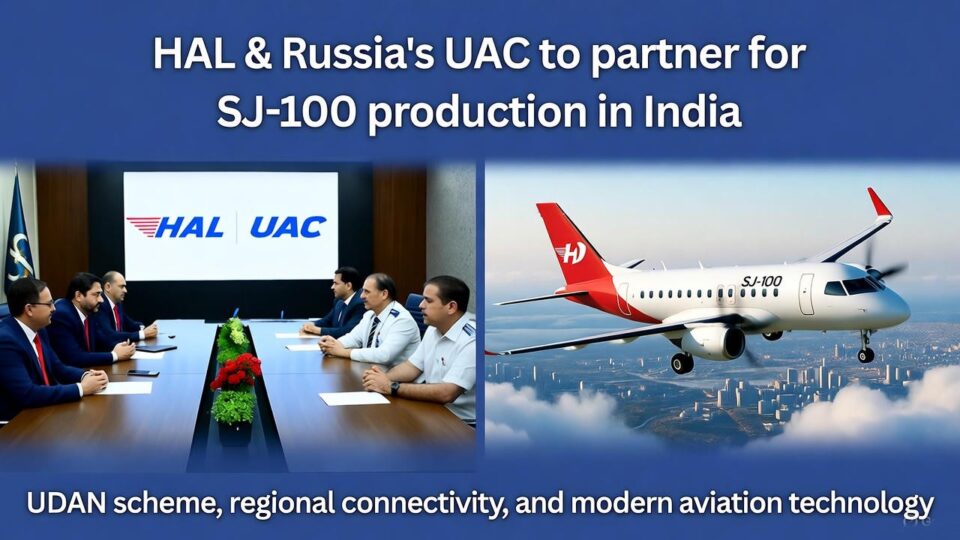
HAL Partners with Russia’s UAC to Produce SJ-100 Aircraft in India
October 28, 2025 – Hindustan Aeronautics Limited (HAL), a leading Indian aerospace firm, has signed a Memorandum of Understanding (MoU) with Russia’s Public Joint Stock Company United Aircraft Corporation (PJSC-UAC) to build the SJ-100 regional passenger aircraft in India. The agreement was finalized in Moscow on October 27, 2025. This initiative supports India’s goals for greater independence in civil aviation and aims to improve short-distance air travel through the UDAN (Ude Desh ka Aam Naagrik) program.
The collaboration between HAL and UAC is expected to support India’s growing aviation needs, including demand for more than 200 regional aircraft over the next ten years and around 350 additional planes for routes in the Indian Ocean area. With air travel in India projected to triple by 2030, local production of the SJ-100 may generate numerous jobs, encourage private industry participation, and help establish India as an important contributor to worldwide aircraft manufacturing.
The SJ-100: Suited for India’s Regional Routes


The SJ-100 is a twin-engine regional jet with space for 75 to 100 passengers and a range of up to 3,000 kilometers. It is designed for efficient operation on shorter flights. More than 200 of these aircraft are currently in use by 16 airlines around the world. Key features include reduced operating expenses, modern navigation systems, and the ability to use eco-friendly fuels, which make it appropriate for India’s varied regional air networks.
Through the MoU, HAL will have the rights to manufacture the SJ-100 for the Indian market, applying its experience in aircraft building, electronics integration, and supply management gained from military projects. This partnership extends the established cooperation between India and Russia from defense to commercial aviation, promoting shared technical knowledge.
The signing was attended by key officials, including HAL’s Chairman and Managing Director, Dr. D.K. Sunil, and PJSC-UAC’s Director General, Vadim Badeka, highlighting the importance of this joint effort.
Supporting the UDAN Program: Improving Access to Remote Areas

Introduced in 2016, the UDAN scheme has linked more than 50 previously underserved airports in India, making air travel more accessible for people in distant locations. A major challenge has been the availability of suitable and affordable aircraft for short routes. The SJ-100 could help overcome this by offering economical options for flights under 500 kilometers, potentially lowering ticket prices and allowing more frequent services.
Producing the aircraft locally is anticipated to reduce reliance on imports, cut costs by 20-30 percent via domestic assembly, and boost related sectors such as parts production and aircraft maintenance services. This development comes as India’s aviation sector ranks as the third-largest globally and continues to expand rapidly, with emphasis on regional links in national aviation policies.
The SJ-100 also fits with environmental objectives, as its structure allows for future hybrid-electric modifications that could decrease fuel use and emissions by up to 15 percent on brief flights. For major Indian carriers focused on regional operations, such as IndiGo and SpiceJet, this presents opportunities for updating fleets at lower costs compared to imported alternatives.
Building on India-Russia Aerospace Ties


HAL’s entry into commercial aircraft manufacturing continues a historical tradition. The previous fully Indian-made passenger plane was the Avro HS-748, built by HAL from 1961 to 1988. In recent years, India has depended on foreign suppliers for civilian jets, though projects like the C295 transport aircraft with Airbus have strengthened HAL’s skills for non-military applications.
UAC, a major Russian aerospace company known for aircraft such as the Sukhoi Su-57 and MC-21, provides established knowledge in regional jet design. The SJ-100, previously known as the Sukhoi Superjet 100, has been updated with new PD-8 engines to maintain reliable supplies despite international restrictions.
This MoU adds to ongoing India-Russia agreements, including defense systems like the S-400 and the BrahMos missile project, demonstrating strong relations in changing global conditions. It also supports India’s own efforts, such as the Regional Transport Aircraft program led by the National Aerospace Laboratories.
Outlook: Employment, Technology, and International Opportunities


The project is likely to have broad impacts. HAL plans to add over 5,000 jobs at its sites in Bengaluru and Nashik, while supporting small and medium enterprises in smaller cities. Training initiatives could prepare more than 10,000 individuals in areas like modern production techniques, electronics, and advanced materials.
In the future, the SJ-100 produced in India might be exported to regions like Southeast Asia and Africa, using UAC’s international connections and HAL’s competitive production advantages. Government support through incentive programs for aerospace manufacturing is expected to speed up progress, with initial aircraft possibly ready by 2028.
This HAL-UAC agreement represents a step forward in India’s aviation development, aiming to enhance connectivity across the country and contribute to its role in global aerospace.
follow us:-Pentoday | Facebook


