


S Jaishankar: World’s Shift to Multipolarity Demands Deeper Multilateralism
External Affairs Minister (EAM) S. Jaishankar asserted that the world’s clear movement towards multipolarity makes a compelling and necessary case for “deeper multilateralism.” Speaking on Sunday, December 7, 2025, at the inaugural ceremony of the 20th session of the UNESCO Intergovernmental Committee for the Safeguarding of Intangible Cultural Heritage in New Delhi, the EAM emphasized that collective prosperity can only be achieved through mutual respect and understanding.
The Case for Deeper Multilateralism
Jaishankar’s remarks tie India’s foreign policy outlook to the shifting global structure, highlighting a world characterized by multiple centers of power, rather than one or two dominant nations.
-
Multipolarity as a Reality: He stated that the political and economic rebalancing that began with decolonization is now leading the world back to its “natural diversity.” This process, which sees multiple voices from across geographies gaining expression, naturally leads to a multipolar world order.
-
Prosperity through Respect: The EAM stressed that in this increasingly pluralistic landscape, collective progress requires nations to look beyond dominance.3 He emphasized that the only path to prosperity is through mutual respect and mutual understanding, suggesting that current multilateral institutions must be reformed and strengthened to accommodate this new reality.
-
Cultural Rebalancing: Jaishankar linked global political rebalancing to the need for cultural rebalancing. He argued that the political and economic shifts remain incomplete until the world fully appreciates and safeguards its diverse cultural inheritance, cautioning against efforts to “dominate, sideline, dismiss or even to erode” the culture of others.
India’s Role as a Civilisational State
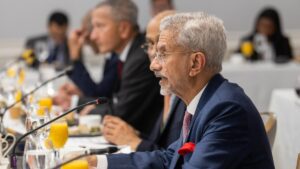
Speaking at the UNESCO meeting at the Red Fort complex, a UNESCO World Heritage Site, the Minister underscored India’s unique sensitivity to cultural concerns as a “civilisational state” and a champion of the Global South.
-
Focus on Intangible Heritage: Jaishankar noted that the safeguarding and revival of intangible cultural heritage—such as traditions, festivals like the Kumbh Mela and Durga Puja, craftsmanship, and local arts—is a core part of India’s diplomatic engagement.
-
Multilateralism in Action: He praised UNESCO for being at the forefront of multilateralism and for making an invaluable contribution to cultural protection, noting that India is proud that its diplomatic efforts prioritize both tangible and intangible heritage.
The minister’s message reinforces India’s stance that in a world with many competing powers, solving complex global challenges like conflicts, economic volatility, and climate change requires more collaborative frameworks, or deeper multilateralism, based on the principle of the world as a family.
FOLLOW US:-Pentoday | Facebook
