


Digital Payments in India Hit Lowest Point in FY26
October 10, 2025:- In a surprising twist to India’s booming digital economy, September 2025 marked the lowest digital transaction volumes of the fiscal year 2025-26 (FY26). As the nation gears up for festive shopping sprees, experts point to one key culprit: consumers playing the waiting game for long-awaited Goods and Services Tax (GST) reductions. This dip in digital payments in India has raised eyebrows, but it could signal a spending surge once the cuts kick in fully.
A Sharp Drop in Digital Transaction Volumes
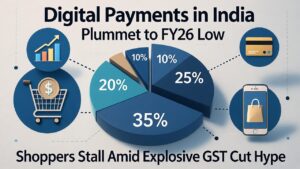
According to the latest data from the Reserve Bank of India (RBI) and payment aggregators, digital transaction volumes across platforms like UPI, cards, and wallets plummeted by nearly 12% compared to August 2025. UPI, India’s darling of seamless payments, saw over 14 billion transactions in September—down from a peak of 16.2 billion in July. Overall digital payment volumes in India for the month hovered around 18.5 billion, the weakest since April 2025 when summer slowdowns were blamed.
Value-wise, things weren’t all gloom. Online credit card spending bucked the trend, hitting a record ₹2.8 lakh crore, fueled by early e-commerce festive deals on sites like Amazon and Flipkart. But for everyday buys—think groceries, fuel, and small retail—people just weren’t swiping or scanning as much.
“This isn’t a sign of distress in the digital payments ecosystem,” says Rajeshwari Sharma, fintech analyst at Ambit Capital. “It’s more like a collective pause button. Indians are savvy shoppers; they’re holding off on big-ticket items until prices drop post-GST tweaks.”
The GST Cut Hype: What Sparked the Wait-and-Watch Mode?

The buzz around GST rate cuts in India 2025 started building in early August, when hints of reforms surfaced. Prime Minister Narendra Modi sealed the deal in his Independence Day address on August 15, promising “next-generation GST reforms” to ease the burden on everyday consumers. The GST Council, in its landmark 56th meeting on September 3-4, rolled out the details: a simplified two-slab structure of 5% and 18%, scrapping the 12% and 28% brackets for most goods, and axing the compensation cess by March 2026.
These changes, dubbed GST 2.0, took effect on September 22, 2025, slashing taxes on over 200 items. Essentials like groceries and daily food items now attract just 5% GST, potentially trimming household bills by up to 13%. White goods—think air conditioners, refrigerators, and TVs—dropped from 28% to 18%, making that festive upgrade more affordable. Small car buyers could save a whopping ₹70,000, while life and health insurance premiums got a full 18% relief.
But here’s the catch: The first three weeks of September were mired in anticipation. “Business was sluggish until the 22nd because everyone was betting on lower prices,” notes a report from the Finance Ministry. Even with the announcement, supply chains took time to adjust, leading to postponed purchases. Discretionary spending, already tempered by a sluggish job market (corporate wage growth at a modest 7% YoY), took the biggest hit.
Broader Economic Ripples: From Festive Blues to Future Boom?
September’s slowdown comes at an awkward time. The festive season—Diwali, Dussehra, and Navratri—typically juices UPI transaction volumes by 20-30%. Last year, digital payments soared to ₹25 lakh crore during the quarter. This time, early indicators show a rebound in late September, with UPI volumes ticking up 8% week-on-week post-GST implementation.
Economists are optimistic. “These GST reforms 2025 aren’t just tax tweaks; they’re a consumption catalyst,” says Dr. Anjali Patel, economist at Kotak Mahindra Bank. By freeing up ₹48,000 crore in potential revenue (offset by hikes on luxury items to 40%), the government aims to boost demand in FMCG, autos, and durables. Rural areas, where unorganized retail dominates, stand to gain the most as prices align closer to informal markets.
Yet, challenges linger. A stagnant formal job market and rising input costs could cap the upside. The opposition, including Congress, has critiqued the reforms as “inadequate,” demanding extended state compensations. Still, PM Modi’s “GST Savings Festival” pitch has struck a chord, with social media abuzz over savings on everything from stationery (now tax-free) to two-wheelers.
What Does This Mean for Digital Payments and Your Wallet?
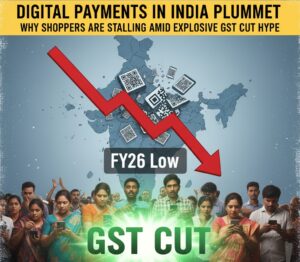
For fintech giants like PhonePe and Google Pay, September’s dip is a blip. UPI’s share in total digital payments remains a robust 80%, and innovations like credit-on-UPI are poised to drive growth. But for consumers, it’s a reminder: In an era of real-time digital transactions in India, timing is everything.
If you’re eyeing that new fridge or Diwali gold, the post-September 22 window is golden. Analysts predict a 15-20% spike in transaction volumes by November as pent-up demand unleashes. “The GST cuts will supercharge organized retail and e-commerce,” Sharma adds. “Expect more QR scans and fewer cash stashes.”
As India chases its $5 trillion economy dream, this GST-fueled pause might be the calm before a digital storm. Stay tuned—your next tap could save you big.
This article is for informational purposes only and draws from public economic data. For personalized financial advice, consult a professional.
Related Reads:
आरबीआई RBI launches revolutionary Deposit Tokenization Pilot Program 2025
for more :- Goods & Services Tax (GST) | Home
