






November 17, 2025:- In a watershed moment for South Asian politics, Bangladesh’s International Crimes Tribunal (ICT) in Dhaka has delivered a death sentence to former Prime Minister Sheikh Hasina on charges of crimes against humanity. The verdict, announced on Monday, November 17, 2025, relates to the brutal crackdown on the massive student-led uprising in July and August of last year, a movement that ultimately toppled her fifteen-year rule.
The Charges and the Conviction

The three-member tribunal convicted Sheikh Hasina in absentia, finding her responsible as the “mastermind and principal architect” behind the violence. Specifically, the court found her guilty on multiple counts of crimes against humanity, including incitement, ordering killings, and a failure to prevent widespread atrocities committed by state forces and her ruling party’s affiliates.
The trial centered on the events of the so-called “July Uprising” of 2024, which began as student protests against a controversial government job quota system but rapidly escalated into a mass movement demanding Sheikh Hasina’s resignation. According to a subsequent report by the United Nations, up to 1,400 people may have been killed in the violence between July 15 and August 5, making it the deadliest period of unrest since the 1971 War of Independence.
The prosecution successfully argued that Sheikh Hasina used her position of authority to unleash a deadly, premeditated assault on civilians. Key pieces of evidence cited in the 453-page judgment included:
-
Orders for Lethal Force: Direct evidence suggesting Sheikh Hasina issued orders to use lethal weapons, drones, and helicopters against unarmed student protesters.
-
Mass Killings: Responsibility for specific incidents, such as the killing of six protesters at Chankharpul on August 5, 2024, and the high-profile shooting of student activist Abu Sayeed.
-
Command Responsibility: Being held liable not only for direct command but also for a systemic failure to prevent or punish the murder, torture, and enforced disappearances carried out by the police, Rapid Action Battalion (RAB), and her party’s student wing.
The tribunal also handed a death sentence to former Home Minister Asaduzzaman Khan Kamal and sentenced former Inspector General of Police Chowdhury Abdullah Al-Mamun to five years after he pleaded guilty and became a state witness.
Hasina’s Fierce Denunciation and Legal Tangle

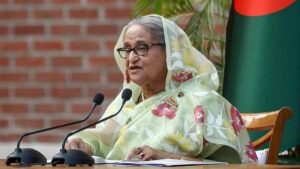
The former Prime Minister Sheikh Hasina, who fled to India shortly after her ouster and remains there in exile, issued a blistering statement in response to the verdict. She fiercely denounced the ruling as “biased and politically motivated,” calling the International Crimes Tribunal a “rigged tribunal established and presided over by an unelected government with no democratic mandate.” Sheikh Hasina argued that the death sentence reveals a deliberate attempt by her political rivals to eliminate her and the Awami League from the political scene ahead of potential national elections.
The immediate focus now shifts to the complex legal and diplomatic aftermath:
-
Extradition Uncertainty: The interim government, led by Nobel Laureate Muhammad Yunus, is expected to renew its request for Sheikh Hasina’s extradition from India. However, the 2013 India-Bangladesh Extradition Treaty allows India to refuse if the alleged offense is deemed political in nature, a defense her party is certain to leverage.
-
Appeal Process: Sheikh Hasina retains the right to appeal the verdict to the Supreme Court’s Appellate Division, but this typically requires the convicted person to either surrender or be arrested.
Tensions Ahead of Elections
The dramatic conviction has plunged Bangladesh into a state of heightened political tension. The capital, Dhaka, was placed under a sweeping security lockdown, with police and paramilitary forces deployed amid reports of scattered violence and crude bomb blasts following the announcement.
The ruling comes as the interim government plans to hold national elections in early February 2026, an election the Awami League has been barred from contesting. This death sentence solidifies the political exile of the country’s most dominant figure of the last two decades and ensures that her legal battle will remain a central and destabilizing factor in Bangladesh’s turbulent transition to democracy.
also read:-देविका रोटवान Devika Rotawan Fearless at 9: How Brave Little Defeated Kasab and Won Justice
follow us:-Pentoday | Facebook


