

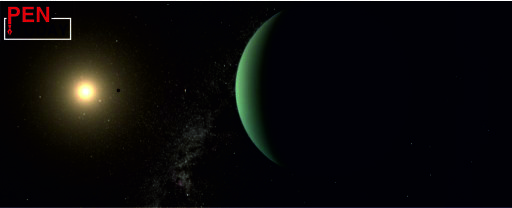
Astronomers have recently confirmed the existence of an exoplanet that may have the potential to support life, and it’s surprisingly close to our Solar System. The planet, HD 20794 d, orbits a star just 20 light-years away and has several key traits that suggest it could be habitable. With a mass just under six times that of Earth, it resides in the “habitable zone” of its Sun-like star, where liquid water might exist.
Astrophysicist Michael Cretignier from Oxford University expressed his excitement over the discovery, noting that confirming the planet’s existence was a relief after initial uncertainties due to the faintness of the signal. The planet’s proximity makes it an excellent candidate for future space missions, potentially even capturing an image of it.
The search for habitable planets often focuses on the presence of liquid water, which is essential for life as we know it. A planet must be at just the right distance from its star – too close, and any water would evaporate; too far, and it would freeze. This “habitable zone” is a key factor in determining whether a planet could sustain life.
HD 20794, the star around which the planet orbits, is a yellow dwarf star similar to our Sun. It’s slightly smaller and older, which makes it an ideal candidate for hosting stable, life-supporting exoplanets. In 2011, astronomers discovered three exoplanets orbiting this star, but further information remained elusive until 2022, when Cretignier detected a subtle, periodic wobble in the star’s spectrum, which indicated the presence of a planet.
After collecting additional data using advanced instruments, the researchers were able to confirm the planet’s existence. HD 20794 d has a minimum mass of 5.82 times that of Earth, with a radius roughly 1.7 to 2.1 times larger. Its orbit, taking 648 days to complete, places it within the habitable zone. However, the planet’s elliptical orbit means only part of it lies within this zone, and at the farthest point, it moves out of the zone where water would be too cold to exist.
The exact composition of HD 20794 d remains uncertain, as astronomers are unsure of its radius, which would help determine whether it is a rocky, Earth-like super-Earth or a gas-rich mini-Neptune. Future research will be critical to understanding its potential for habitability.
Cretignier expressed his enthusiasm for the discovery, particularly given the planet’s proximity and its unusual orbit. He looks forward to further insights from other scientists, especially since HD 20794 d is one of the closest Earth-like planets found to date.
Disclaimer:-The study has been published in Astronomy & Astrophysics.
